Blog

Script Breakdown Made Simple 6 Essential Steps for Indian Productions

In the high-stakes world of Indian cinema, where a single day of an "over-schedule" shoot can bleed lakhs of rupees, the Script Breakdown is your primary insurance policy. Whether you are working on a massive pan-India blockbuster or a gritty Mollywood indie, the breakdown is the bridge between a creative dream and a logistical reality.

A script breakdown is the process of analyzing a screenplay to identify every single resource required for production: from the lead actors to a specific type of Chai glass needed for a 1980s period piece.

Why This Guide Matters for Indian Filmmakers

Unlike Western workflows, Indian productions often deal with unique variables: massive crowd scenes, unpredictable weather (the Monsoon factor), and diverse regional logistics. This guide adapts global standards into a localized Indian Production Workflow.

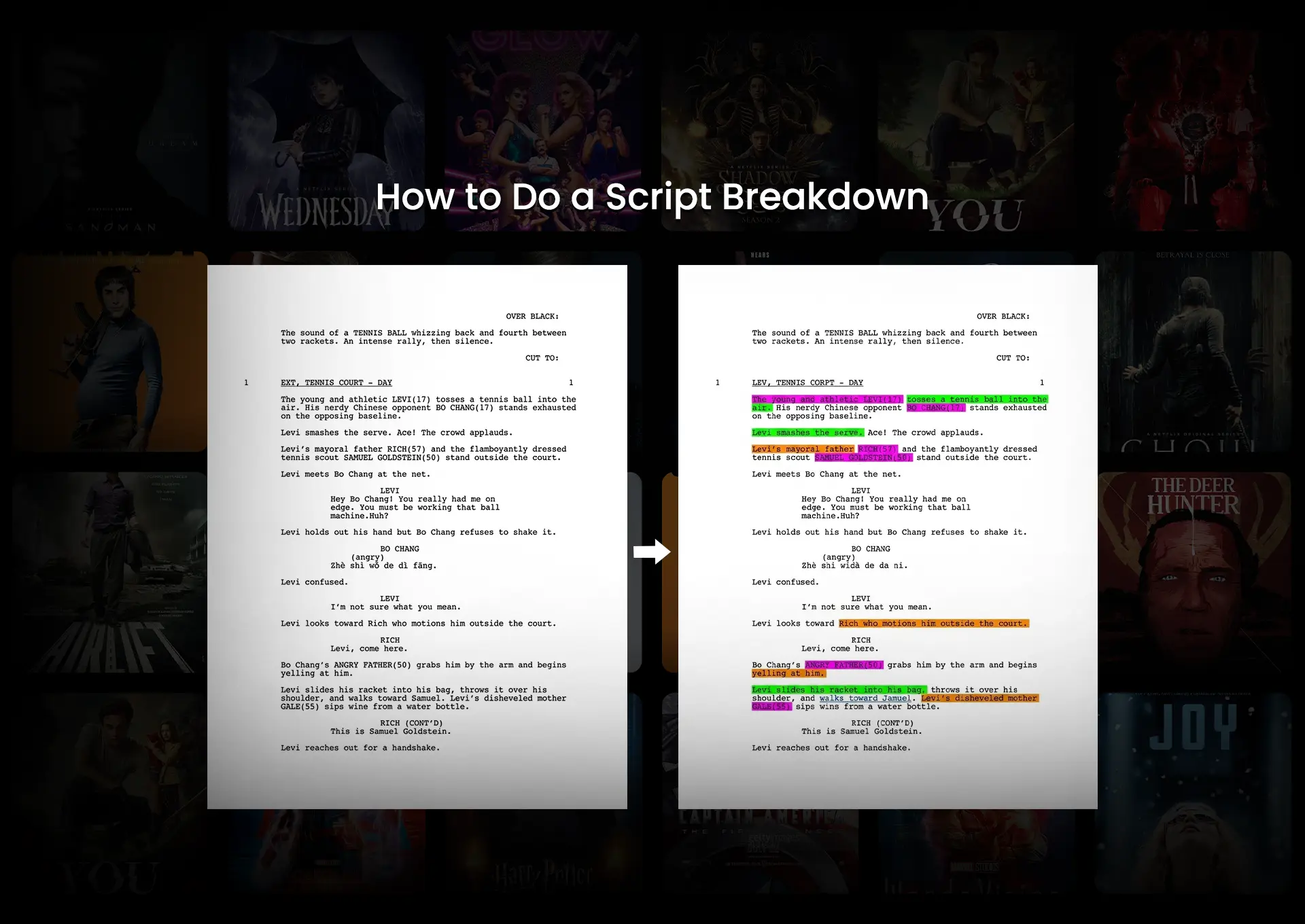
"Script breakdown example for film production workflow with highlighted screenplay elements."

Step 1: The "Creative" First Read-Through

Before you pick up a highlighter or open your Script Breakdown Software, you must read the script purely as a storyteller.

The Goal: Understand the emotional arc and the "vibe" of the film.

  • Why? If you don’t understand the tone, you might misinterpret a "small gathering" in the script. In an Indian context, a "small family wedding" in a script could mean 50 people or 500.
  • Action: Take notes on the "implied" scale. Does the script feel intimate (like a chamber drama) or expansive?

Step 2: The Technical "Lining" (The 1/8th Rule)

Once the creative read is done, it’s time for the technical pass. This is where you divide each page into one-eighths. This is the universal language of production scheduling.

The Page Count Formula

To determine the length of a scene for scheduling, we use the following logic:

If a scene occupies 2.5 inches on a standard page (where 8 inches = 1 page), the math is:

$$ \text{Scene Length} = \frac{\text{Inches of Dialogue/Action}}{8} $$

In our example, that is $2/8$ or $3/8$ of a page.

Pro-Tip for Indian ADs: In regional scripts where formatting might not strictly follow the "Courier 12pt" rule, be careful. If the font is larger, your 1/8th counts will be off, leading to a disastrously optimistic schedule.

Step 3: Identifying and Categorizing "Elements"

This is the core of the breakdown. You must go through the script and identify "Elements"—anything that costs money or requires a person to manage it.

In the Indian workflow, we use the Standardized Color Coding System:

  • Cast (Red): Every speaking role.
  • Stunts (Orange): Crucial for South Indian action-heavy cinema.
  • Props (Violet): Anything handled by actors (e.g., a thali, a smartphone).
  • Vehicles (Pink): Rickshaws, vintage cars, or luxury SUVs.
  • Greenery (Green): Important for Kerala outdoor shoots or interior set dressing.
  • Special Effects (Blue): Rain machines, smoke, or squibs.
  • Entity Salience Tip: Don't forget the "Extra-Atmosphere." In India, "Crowd" is often its own massive department. Tag it early!

Step 4: Creating the Script Breakdown Sheet

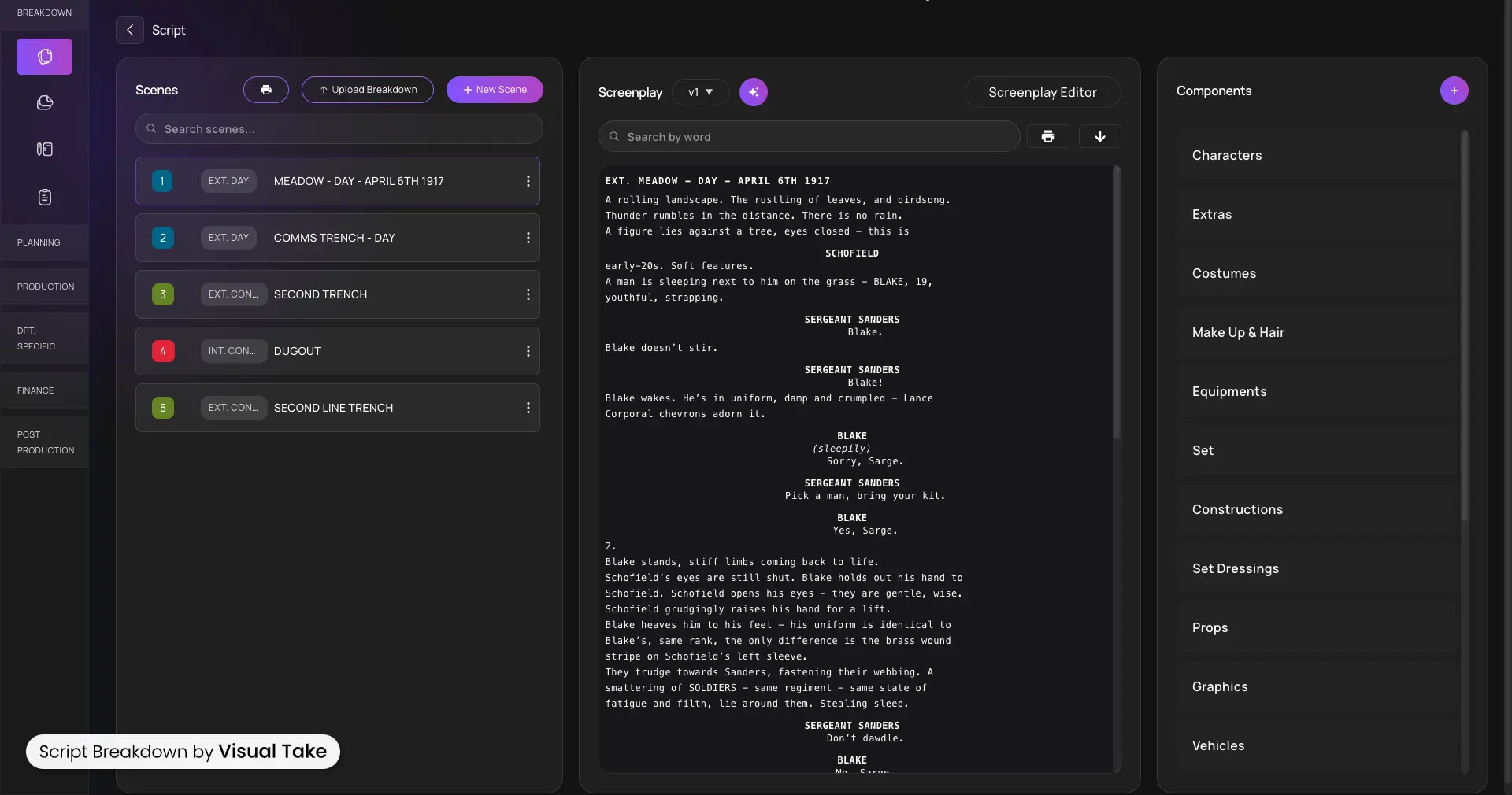
Every scene gets its own Breakdown Sheet. This is a data-entry task that can be done manually in Excel or via specialized Script Breakdown Software.

Critical Data Points for Indian Sets:

  1. Scene Number & Slugline: (e.g., INT. TRIVANDRUM TEA SHOP - DAY).
  2. Scene Synopsis: A one-sentence summary.
  3. Element Lists: All the items you highlighted in Step 3.
  4. Production Notes: Mention specific Indian logistics here—like "Need permissions for Temple shoot" or "Check for local festival noise interference."

Step 5: The "Recce" & Elements Validation

A breakdown done in an office is just a theory. In the Indian production cycle, the Recce (Location Scouting) is where the breakdown meets reality.

  • The Validation: You noted "Vehicle: Rickshaw" in your breakdown. During the recce in a narrow lane in Old Delhi, you realize a rickshaw can't turn around there.
  • The Update: You must update the breakdown sheet to reflect "Manual Pull-Cart" instead.
  • The Indian Context: Always account for Sync Sound challenges. If you are shooting in a noisy Kochi market, your "Sound" element needs to include "Extra Lapel Mics" or "Post-Sync ADR."

Step 6: Syncing with the Stripboard (The Schedule)

The final step is taking all those breakdown sheets and turning them into a Production Board or Stripboard. This is where you decide what to shoot and when.

The "Indian Monsoon" Rule: When scheduling, always group your "EXT" (Exterior) scenes together during clear weather windows and keep "INT" (Interior) scenes as "Cover Sets" for rainy days.

Top Script Breakdown Software for Indian Filmmakers

For those looking to move beyond manual Excel sheets, here is a comparison of the best tools available in the Indian market:
Software
Best For
Price Point (Approx)
Pro/Con
StudioBinder
Professional ADs
Subscription (High)
Best UI/UX; expensive for indies.
Celtx
All-in-one Production
Mid-range
Great for collaboration across departments.
Trelby
Budget/Indie Projects
Free (Open Source)
Good for basic lining; lacks advanced scheduling.
The industry standard for Bollywood/Hollywood.
Movie Magic
Industrial Scale
High (One-time)

StudioBinder

Best For
Price Point (Approx)
Professional ADs
Subscription (High)
Pro/Con
Best UI/UX; expensive for indies.

Celtx

Best For
Price Point (Approx)
All-in-one Production
Mid-range
Pro/Con
Great for collaboration across departments.

Trelby

Best For
Price Point (Approx)
Budget/Indie Projects
Free (Open Source)
Pro/Con
Good for basic lining; lacks advanced scheduling.

The industry standard for Bollywood/Hollywood.

Best For
Price Point (Approx)
Movie Magic
Industrial Scale
Pro/Con
High (One-time)
"Digital script breakdown dashboard with scene management and production components."

Local Nuances: Breaking Down Scripts in India

When optimizing your workflow for the Indian landscape, consider these three "High-Impact" factors:

1. The Regional Linguistic Layer

If you are working on a bilingual film (e.g., a Tamil-Malayalam crossover), your breakdown must account for different Dialogue Coaches and potentially longer shoot times for "Double-Action" scenes where the same scene is shot in two languages.

2. Unit Management & Catering

In Western breakdowns, catering is a line item. In India, the "Unit" size can be 200+ people. Your breakdown must signal to the Production Manager when a scene has "Extra Crowd," as this exponentially increases the cost of "Bata" (daily allowance) and food.

3. Local Citations & Unions

Ensure your breakdown aligns with the guidelines of organizations like IFTDA (Indian Film & Television Directors' Association) or FEFKA (Federation of Western India Cine Employees) regarding working hours and turnaround times for cast and crew.

Frequently Asked Questions(FAQ)

1. What is a script breakdown in film production?

A script breakdown is the process of analyzing a script to identify all production elements such as cast, locations, props, costumes, and equipment needed for filming.

2. Why is a script breakdown important before production?

It helps production teams plan resources, create schedules, manage budgets, and ensure a smooth filming process.

3. What are the main elements included in a script breakdown?

Key elements include characters, locations, props, costumes, makeup, special effects, vehicles, and production equipment.

4. Who is responsible for creating a script breakdown?

Script breakdowns are typically prepared by assistant directors, production managers, line producers, or other pre-production team members.

5. How does a script breakdown improve production efficiency?

By organizing all production requirements in advance, it reduces delays, improves coordination, and helps keep the project on schedule and within budget.
All in one film production suite background
Movytech Innovations

All in one film production suite

Powered by movytech