Blog

The Ultimate Guide to AI Script Breakdown Software in India [2026]

The film production office of 2026 looks remarkably different than it did even five years ago. If you walk into a production house in Mumbai’s Andheri West, a bustling studio in Kochi’s Kakkanad, or a high-tech set in Hyderabad’s Film City, you won’t see Assistant Directors (ADs) buried under a mountain of physical scripts, armed with eight different colors of highlighters.

The "breakdown"—the foundational process of identifying every cast member, prop, vehicle, and costume needed for a shoot—has been revolutionized. What used to take a dedicated team of three people nearly a week of sleepless nights is now being accomplished in a matter of minutes.

The catalyst? AI script breakdown software.

However, as the Indian film industry—the largest in the world by volume—continues to produce content in over 20 languages with vastly different cultural nuances, not every software is up to the task. Some "global" tools struggle with the linguistic blend of a Hinglish script, while others fail to understand the logistical chaos of a 500-person crowd scene in a rural Indian village.
In this comprehensive guide, we rank and compare the best AI script breakdown software available in India in 2026, helping you choose the right tool for your specific production needs.

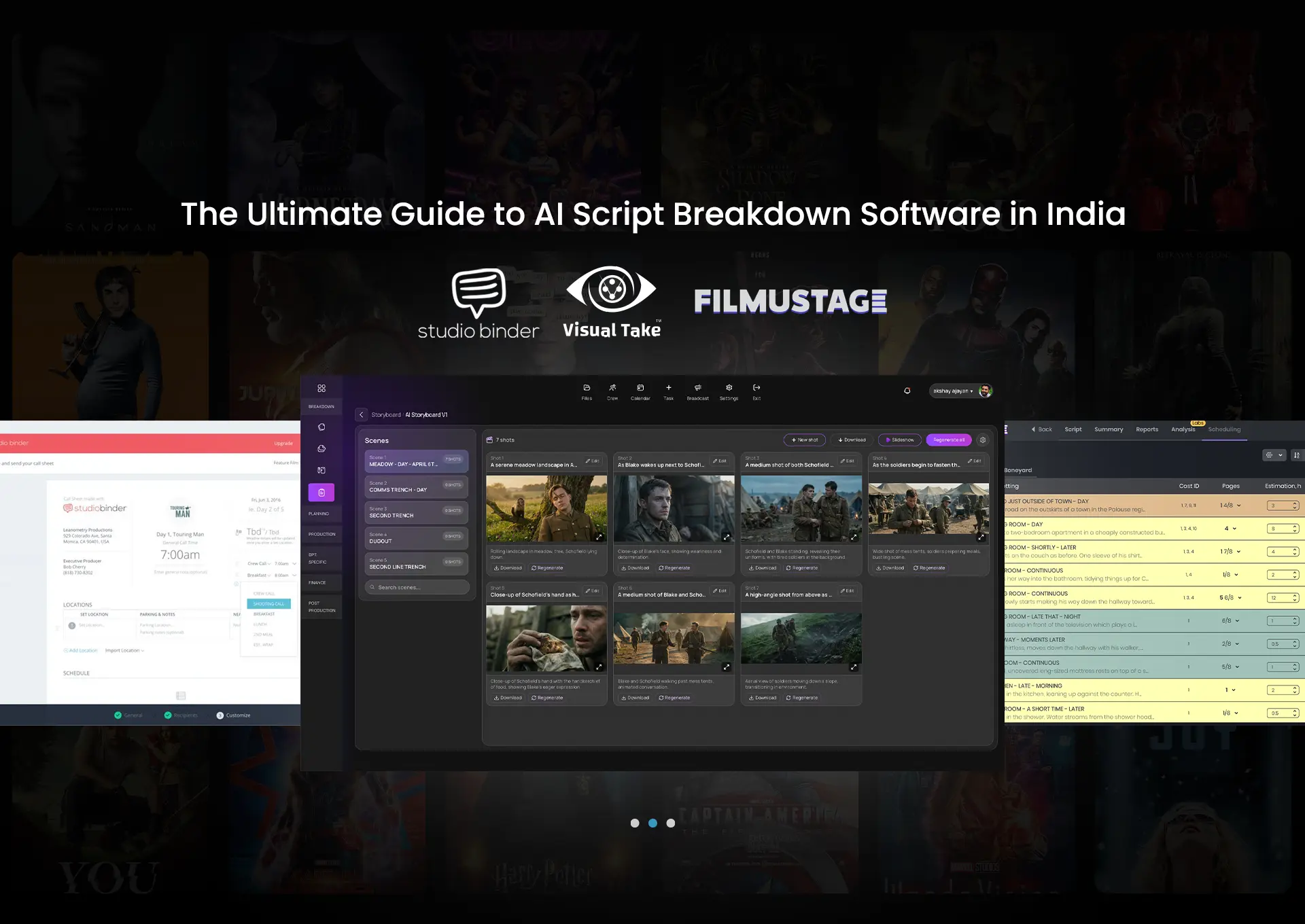
Dashboard comparison of AI script breakdown software in India featuring StudioBinder, Visual Take, and Filmustage for film production management in 2026.  File Name:

1. The Death of the Highlighter: Why AI is the New Industry Standard

In the "old days" (pre-2023), the script breakdown was a rite of passage for every junior AD. It was a manual, error-prone, and exhausting process. You had to read every line, identify the "elements," and transfer them to breakdown sheets. If a script revision came in at 2:00 AM, you had to start the process all over again.

By 2026, the Indian film industry has shifted toward "Smart Production." With the rise of massive "Pan-India" spectacles and the explosion of high-quality streaming content, schedules are tighter than ever.

The Benefits of AI Adoption:

  • Time Efficiency: A 120-page feature film script can be processed and categorized in roughly 90 seconds.
  • Budget Accuracy: By identifying every element—from a vintage car to a specific type of South Indian jewelry—AI allows line producers to generate more accurate cost estimates instantly.
  • Error Reduction: AI doesn’t get tired. It won’t miss the fact that a character is carrying a specific prop in Scene 42 that needs to reappear in Scene 108.
  • Dynamic Updating: When the writer changes a location from a "Cafe" to a "Bus Station," the AI updates every affected department’s list automatically.

2. Key Criteria: What Makes a Software

Before we dive into the rankings, it is important to understand the criteria we used. Most software is designed in Hollywood, but Indian filmmaking has its own unique DNA. To rank highly, a tool must address:

  1. Language Nuance: Can it handle "Hinglish"? Does it understand scripts written in Malayalam, Tamil, or Telugu scripts?
  2. Cultural Context: Does it know that a "Tharavadu" is a specific type of ancestral home requiring distinct art department attention?
  3. Pricing in INR: With fluctuating exchange rates, tools that offer localized pricing or accept Indian payment methods are preferred.
  4. Collaboration: Indian sets are hierarchical and involve large teams. The software must allow seamless sharing between the Director, ADs, Line Producer, and HODs.
  5. Offline Capability: For shoots in remote locations with spotty 5G, a tool that works offline is gold.

3. Top AI Script Breakdown Software: The 2026 Rankings

1. StudioBinder AI

Best For: Large-Scale Bollywood and Pan-India Productions.

StudioBinder has long been the "Apple" of film production software. In 2026, its AI engine is the most polished in the world. It doesn't just tag elements; it creates a visual ecosystem. When you upload a script, it automatically generates breakdown sheets, side-by-side comparisons, and even suggests potential shooting schedules based on location groupings.

  • The India Experience: StudioBinder has made significant strides in recognizing Indian-specific elements. Its AI now correctly identifies "Kurta," "Saree," and "Rickshaw" as wardrobe and transport items with near 100% accuracy.
  • Pros: Beautiful interface, world-class customer support, and a fully integrated suite (Call sheets, DOODs, Storyboards).
  • Cons: It is the most expensive option on the list. For a small indie filmmaker in India, the monthly subscription (often billed in USD) can be a hurdle.

2. Script-it AI

Best For: Regional Cinema (Malayalam, Tamil, Telugu, Kannada).

Based out of the burgeoning tech-film hub in Kochi, Script-it AI has become a favorite for South Indian cinema. Why? Because it was trained on regional datasets. While Western AI often gets confused by the sentence structures of Dravidian languages, Script-it handles them with ease.

  • The India Experience: It offers the best support for Unicode scripts. If your script is written entirely in Malayalam or Tamil, Script-it will still identify the characters, locations, and props with high precision.
  • Pros: Native support for regional languages, localized Indian pricing, and a very responsive dev team that understands the local industry.
  • Cons: The user interface is functional but lacks the high-end "gloss" of StudioBinder.

3. Filmustage

Best For: VFX-Heavy Epics and Action Films.

As India produces more high-concept sci-fi and mythological epics (the Kalki and Brahmastra effect), VFX management has become a nightmare for ADs. Filmustage uses AI to specifically hunt for "VFX cues."

  • The India Experience: If a script says "The hero jumps from the 50th floor while the city crumbles," Filmustage automatically tags this for the VFX department and estimates the complexity. This is invaluable for Indian producers trying to keep CGI costs from spiraling.
  • Pros: Exceptional at identifying "hidden" costs, great for complex action sequences, and offers a "risk analysis" feature for your schedule.
  • Cons: Its focus is very narrow. It’s brilliant for tech-heavy films but might be overkill for a simple domestic drama.

4. Celtx

Best For: Film Students, Indie Creators, and Short Films.

Celtx was one of the first to enter the Indian market with a localized presence. In 2026, their "India Lite" version is the go-to for the thousands of film students and YouTube creators across the country.

  • The India Experience: It is incredibly lightweight. You can run a full breakdown on a tablet or a mid-range smartphone—a necessity for many indie sets in India where high-end laptops aren't always available.
  • Pros: Very affordable, easy to learn, and includes basic scriptwriting tools in the same package.
  • Cons: The AI tagging is less sophisticated than StudioBinder. You will likely need to spend more time "cleaning up" the breakdown manually.

5. Nolan AI

Best For: Writer-Directors and Solo Creators.

NolanAI is a hybrid. It’s an AI scriptwriting assistant that also does breakdowns. For the "one-man-army" filmmaker in India who is writing, directing, and producing their own content, this is a lifesaver.

  • The India Experience: It excels at the "Brainstorming" phase. It can suggest ways to simplify a scene to fit a lower budget based on the breakdown it just generated.
  • Pros: Great all-in-one tool, intuitive "chat" interface where you can ask, "How many scenes involve the car?"
  • Cons: Not robust enough for a professional 1st AD handling a crew of 200.
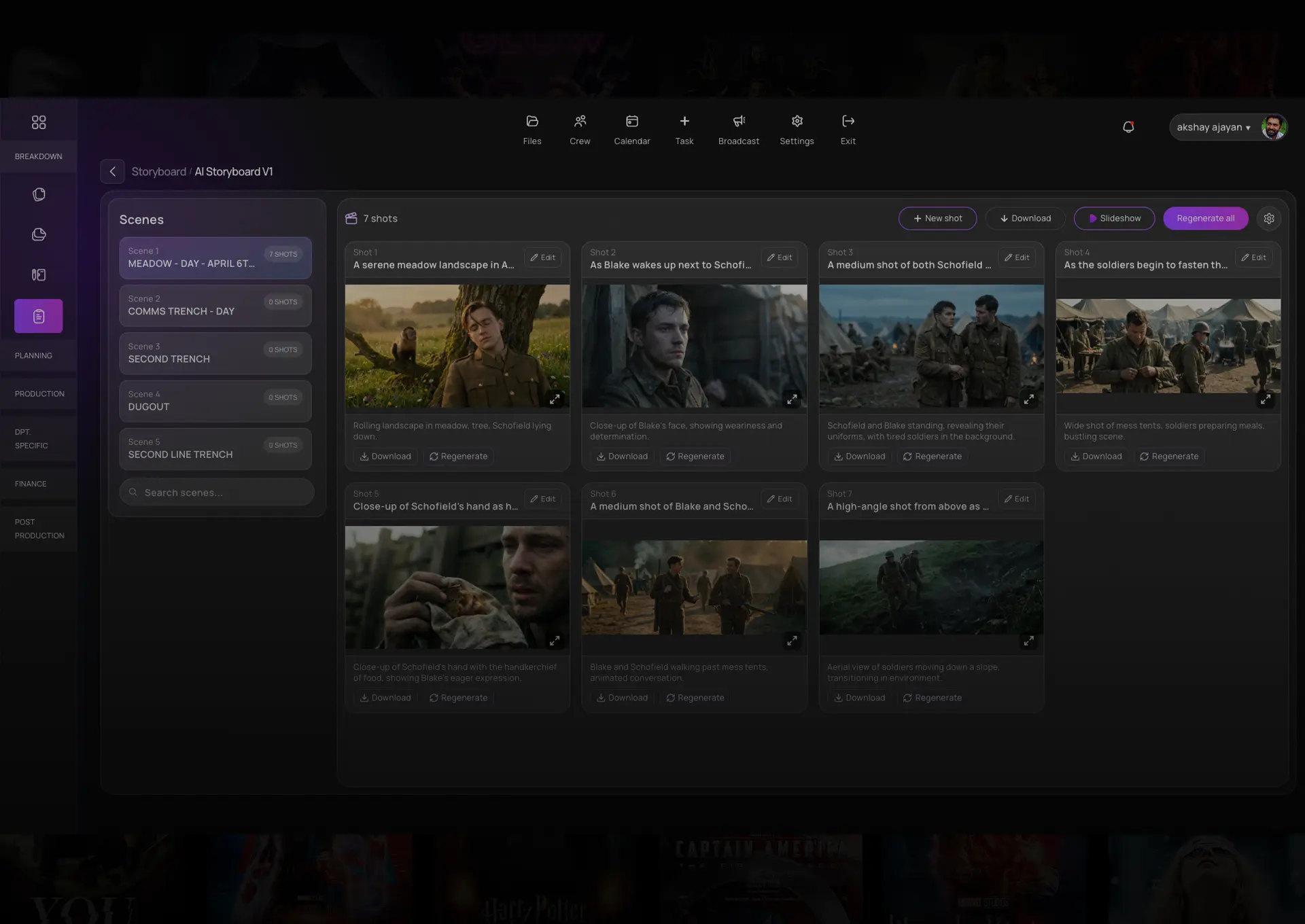
AI-powered film storyboard and script breakdown dashboard interface used for scene planning and production management in Indian filmmaking.

4. The Real-World Impact: A Case Study in Efficiency

Consider a mid-budget Malayalam thriller shooting in the backwaters of Alappuzha. In 2020, the 1st AD would have spent the entire pre-production period manually tracking the "continuity" of props—specifically, a blood-stained letter that moves through five different locations.

In 2026, using a tool like Script-it AI or StudioBinder, that letter is tagged once. The AI then generates a "Prop Tracking Report" showing exactly which scenes the letter appears in, which characters handle it, and what its condition should be (clean vs. stained). This saves hours of debate on set and prevents costly "continuity jumps" that would have required expensive reshoots.

5. Challenges and Limitations of Global AI

Despite the advancements, Indian filmmakers often face "The Hollywood Gap" when using international software.

The Language Barrier

Most global AI is trained on English. While they can handle "Hinglish" to an extent, they often fail to recognize regional slang or culturally specific idioms. A Western AI might see the word "Dada" and think it refers to a "Father" in one context, failing to realize that in a Bengali film set in Kolkata, it’s a term of respect for an elder brother or a local leader.

The "Crowd" Factor

Indian cinema is famous for its massive "Junior Artiste" (background) scenes. Western software often categorizes these as a single "Extras" tag. However, on an Indian set, you might need to categorize these extras into "Villagers," "Police Officers," and "Protesters," each requiring different wardrobe and catering. Global tools often lack the granularity to manage these massive Indian-scale crowds.

6. The Future of Indian Film Tech: Visual Take

While the global players have dominated the market for years, there has been a growing demand for a solution that isn't just "localized"—but "native."

This is where Visual Take enters the conversation.

Visual Take is a Film Production Management software built from the ground up specifically for the Indian Cinema ecosystem. The creators of Visual Take spent years observing the specific "controlled chaos" of Indian film sets, from the frantic production offices of Mumbai to the high-discipline sets of the South.

Why Visual Take is Different:

  1. Built for Regional Complexities: Unlike foreign players that treat regional languages as an "add-on," Visual Take was designed to handle the linguistic diversity of India natively. It understands the rhythm of regional scripts and the specific terminology used by local crews.
  2. Addressing the Drawbacks of Others: The team behind Visual Take identified a common complaint among Indian ADs: Global software is too rigid. Indian filmmaking often requires "on-the-fly" adjustments due to weather, location changes, or actor availability. Visual Take is built with this flexibility in mind, allowing for rapid re-scheduling and re-breaking that reflects the reality of Indian logistics.
  3. Local Logistics Integration: It understands that managing a shoot in a crowded market in Old Delhi is different from shooting in a studio in London. The software includes modules for managing local vendor payments, Indian-style call sheets, and the specific departmental structures (like the "Setting" department vs. the "Art" department) unique to India.
  4. Cultural Sensitivity in AI: The AI within Visual Take is trained to recognize Indian "Entities." It knows the difference between a "Puja" setup and a standard "Party" setup. It understands that a "Pandal" is a structure that requires specific engineering and permits, not just a "tent."

By focusing on the regional complexities that others overlook, Visual Take is positioning itself as the definitive tool for the Indian filmmaker who is tired of trying to fit a "Hollywood peg" into an "Indian hole."

7. How to Transition Your Production to AI

If you are a producer or an AD looking to make the switch in 2026, here is the recommended workflow:

  1. Clean Your Script: AI works best with properly formatted scripts. Use industry-standard software like Final Draft or Highland to ensure your sluglines (INT/EXT) are clear.
  2. Run the First Pass: Upload your script to your chosen tool (e.g., Visual Take for local precision or StudioBinder for global scale).
  3. The "Human" Review: AI is 95% accurate, but it isn't a filmmaker. A senior AD must spend a few hours reviewing the "tags" to ensure the creative intent is maintained.
  4. Sync with Departments: Share the digital breakdown with your HODs (Art, Costume, Makeup). In 2026, they should be able to view their specific lists on their own tablets, adding photos of props or costumes directly into the system.
  5. Live Updates: As the shoot progresses, update the breakdown. If a scene is cut, the software should automatically adjust the requirements for the rest of the schedule.

8. Conclusion: Choosing Your Digital Partner

The choice of AI script breakdown software in 2026 isn't just a technical decision; it’s a strategic one.

  • If you are working on a global co-production where your partners are in LA or London, StudioBinder provides the familiar interface they expect.
  • If you are a VFX-driven production, Filmustage will save you millions in post-production planning.
  • If you are an indie filmmaker on a budget, Celtx remains the reliable entry point.

9. Frequently Asked Questions (FAQ)

1. What is AI script breakdown software in film production?

AI script breakdown software is a digital production tool that automatically analyzes a screenplay and identifies important production elements such as cast, props, costumes, locations, vehicles, VFX requirements, and crowd scenes. Instead of manually highlighting scripts, filmmakers can now generate complete breakdown reports within minutes, improving speed and accuracy during pre-production.

2. Which is the best AI script breakdown software for Indian film productions in 2026?

The best software depends on the type of production:

  • StudioBinder AI is ideal for large-scale Bollywood and Pan-India productions.
  • Script-it AI works best for Malayalam, Tamil, Telugu, and Kannada cinema.
  • Filmustage is excellent for VFX-heavy films and action sequences.
  • Celtx is affordable for indie filmmakers and students.
  • Visual Take stands out as a native Indian production management solution designed specifically for regional workflows and local production logistics.

3. Can AI script breakdown tools handle Indian regional languages?

Yes, some modern AI tools can process Indian regional languages effectively. Platforms like Script-it AI and Visual Take are designed to understand Malayalam, Tamil, Telugu, Kannada, and Hinglish scripts. However, many Western tools still struggle with regional slang, cultural references, and Indian screenplay structures.

4. How does AI script breakdown software help reduce film production costs?

AI tools improve budgeting accuracy by automatically identifying every production requirement in a script. This reduces missed props, continuity errors, scheduling conflicts, and unnecessary reshoots. Producers can estimate costs faster, manage departments more efficiently, and avoid expensive production delays.

5. Is AI script breakdown software suitable for independent filmmakers in India?

Absolutely. Tools like Celtx and Nolan AI offer affordable solutions for indie creators, film students, YouTubers, and small production houses. These platforms provide script breakdowns, scheduling, and basic production management features without requiring large production budgets.

All in one film production suite background
Movytech Innovations

All in one film production suite

Powered by movytech